2025 NABJLA Scholarship & Awards Soirée

The Los Angeles chapter of the National Association of Black Journalists (NABJLA) is excited to host its annual Scholarship & Awards Soirée, which this year will also serve as the organization’s 45th anniversary celebration. A ticketed cocktail ceremony that raises funds to further NABJLA’s mission and purpose, the event will honor three local Black journalists or communications professionals as well as recognize student scholarship recipients.

September 2025 | Black: A Global Construct, Pan-Africanism & Media

September 2025 | Black: A Global Construct, Pan-Africanism & Media

NABJLA presents an intimate conversation with Phillip Scott and Steven Golding exploring how Black identity is constructed across the globe, the legacy and future of Pan-Africanism, and the powerful role of media in shaping narratives of the African Diaspora. Moderated by NABJLA Secretary Nadia "Square Huxtable" Stanley.

Mindful Mixer

In honor of Mental Health Awareness Month, NABJLA is hosting a Mindful Mixer on Saturday, May 17 from 4:30-7pm in partnership with BEAM: Black Emotional and Mental Health Collective. Featuring wellness treatments, curated vendors and mindful moments on the mic, we welcome local journalists and communications professionals to relax, relate and release among colleagues and peers. There’ll be a DJ, light bites and beverages — the perfect stage for low-stakes community building. Bring a friend!

NABLA Members: Free*
Non-Members: $5
*Membership verified at the door.

Ride Sharing Highly Recommended. Street Parking Is Available.

Vendors

February 2025 | Journalism Rewired: Next-Gen Perspectives

Join the National Association of Black Journalists of Los Angeles (NABJLA) on February 25 for an insightful General Body Meeting titled "Journalism Rewired: Next Gen Perspectives." This event will be led by award-winning entertainment reporter Ty Cole and entertainment journalist Alexyz Liggins.

Together, they will share their unique journeys and offer expert insights into navigating the evolving landscape of journalism. Focusing on the challenges and opportunities of representing the new generation in the field, Ty and Alexyz will explore the shifts in storytelling, digital media, and the future of journalism. Don’t miss this chance to engage with these dynamic voices shaping the future of the industry.

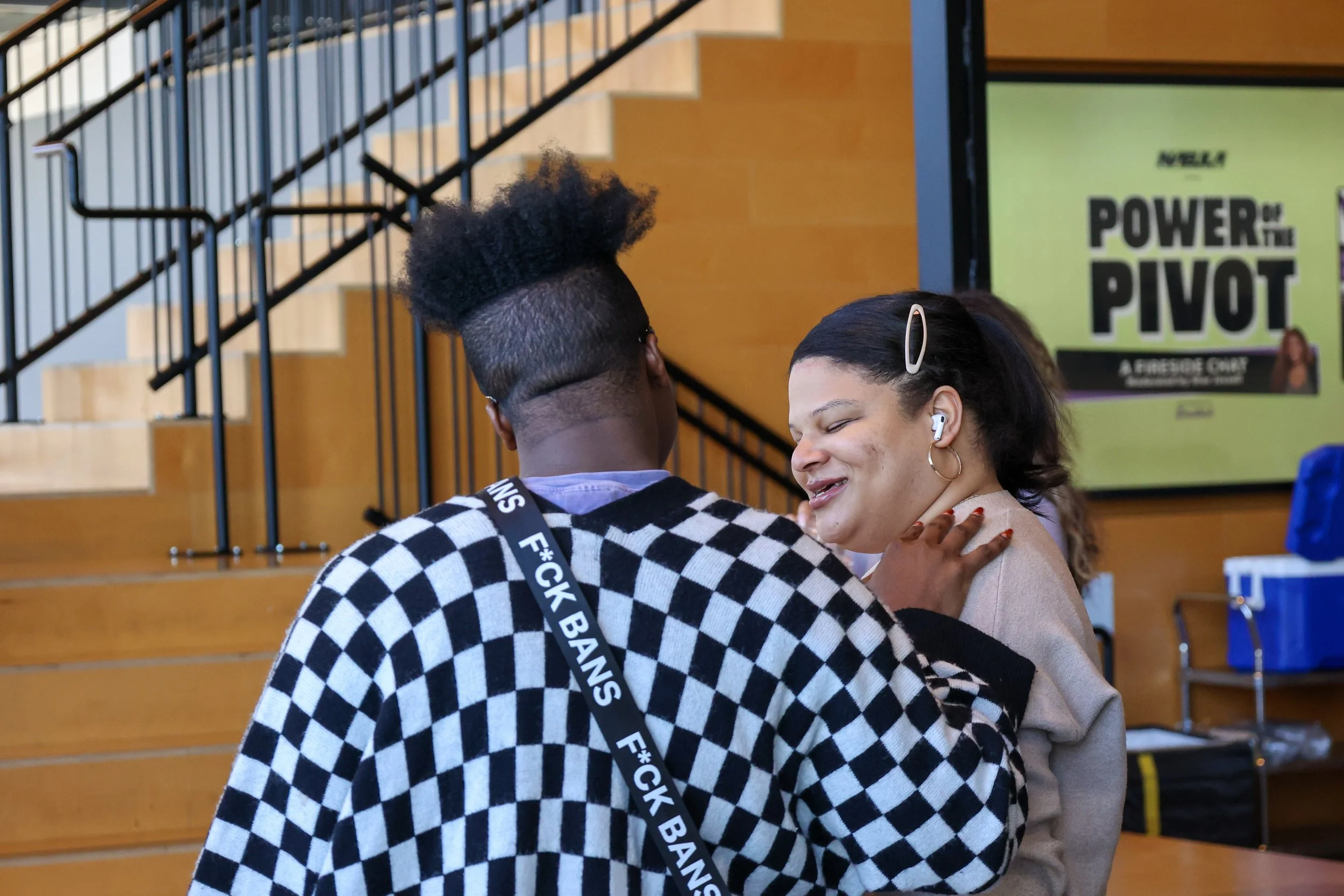
Power of the Pivot with Nina Parker

Join us Saturday, November 16 at 11 a.m. PT for Power of the Pivot, a fireside chat with TV host and fashion designer Nina Parker.

Several newsrooms and companies have been impacted by the squeeze happening across the media industry in recent times leaving many of us asking ourselves “so, what now?” With so many layoffs and organizational restructures happening locally and nationwide, we know things are really hard for our members and colleagues here in LA. Many of you are experiencing job loss and if you are still working, you're probably feeling the burn from doing more with less.

With this in mind, we want to provide a space for our members to hear from someone who has found success throughout her career leveraging her range of skills to master the art of pivoting.

We’ve invited Nina Parker to share her career experience that has been filled with similar challenges. During this one-on-one conversation with NABLJA President Shar Jossell, we’ll have a real talk about all of this and more with an opportunity for guests to join the conversation too.

Location: Deutsch LA (12901 W Jefferson Blvd, Los Angeles, CA 90066)

Time: 11 a.m. PT

Admission: Members - Free | Non-Members - $10 | Students - Free

Registration Required: Everyone who plans to attend must submit a registration form to be put on the list for visitation clearance.

2024 Black Women In Media

Join us Saturday, October 19 at 11 a.m. PT for sixth annual Black Women In Media panel & mixer.

Special guest panelists include award-winning sports and politics journalist Jemele Hill, Los Angeles Times bestselling author of “Read This to Get Smarter” Blair Imani Ali, writer, actor, producer, and author of “Well, That Escalated Quickly: Memoirs and Mistakes of an Accidental Activist” Franchesca Ramsey, and Deutsch’s Vice President of Corporate Communications Camila Crews.

This year’s discussion, moderated by NABJLA President Shar Jossell, focuses on the multifaceted experiences and contributions of Black women in media across the political landscape. With the history-making 2024 presidential election just weeks away, this topic is both timely and critical, as it allows for an in-depth exploration of the unique challenges and perspectives that Black women face in their reporting efforts.

Location: Deutsch LA (12901 W Jefferson Blvd, Los Angeles, CA 90066)

Time: 11 a.m. PT

Admission: Members - Free | Non-Members - $5 | Students - Free

Registration Required: Everyone who plans to attend must submit a registration form to be put on the list for visitation clearance.

NABJLA SCREENS: The American Society of Magical Negroes

EVENT PHOTOS
[Right-Click The Image To Download]

Photo Credit: Robin Marshall (@itsrobinlori)


ABOUT THE FILM

The American Society of Magical Negroes is a fresh, satirical comedy about a young man, Aren, who is recruited into a secret society of magical Black people who dedicate their lives to a cause of utmost importance: making white people’s lives easier.

STARRING

• Justice Smith as “Aren”
• David Alan Grier as “Roger”
• An-Li Bogan as “Lizzie”
• Drew Tarver as “Jason”
• Michaela Watkins as “Masterson”
• Rupert Friend as “Mick”
• Nicole Byer as “Dede”

DIRECTED BY

Kobi Libii

WRITTEN BY

Kobi Libii

PRODUCED BY

• Julia Lebedev, p.g.a.
• Eddie Vaisman, p.g.a.
• Angel Lopez, p.g.a.
• Kobi Libii, p.g.a

EXECUTIVE PRODUCED BY

• Mike Upton
• Oren Moverman
• Leonid Lebedev

GENESIS AND CONCEPT

An alum of both Sundance’s Screenwriters Lab and Directors Labs, THE AMERICAN SOCIETY OF MAGICAL NEGROES represents Kobi Libii’s feature directorial debut. Coming from a background in comedy, Libii says the film started as an idea he assumed would be a short form comedy sketch. “My experience with high concept, comedic ideas like this one is that most of them should be about three minutes long. But when I sat down to flesh it out as a sketch, I discovered that I was writing about something much bigger and far more personal: a very particular defense mechanism that I have been taught as a Black man about how to survive in White America. That defense mechanism has had a number of unintended consequences in my life in terms of my confidence and ability to take up space and my ability to move through the world. ‘The American Society of Magical Negroes’ is an elaborate metaphor to explore all of that.”

Libii continues, “White people write the Magical Negro trope as a kind of ‘Happy Slave’ archetype that imagines Black people truly enjoy contorting themselves to fit into white systems of power. I’m hijacking the trope to explore some of what it really costs Black people to do so.”

For Libii, humor is a part of how he navigates difficult subject matter. “Some of these issues are so raw, that it was important to me to use comedy to make conversation possible. For white people, it can be really unsettling to acknowledge the ways in which a country they love and identify with can still have such troubling power structures, and for Black people, it can be really painful to acknowledge the ways in which we’ve been coerced to adhere to those structures. At least it is for me. And by and large that’s what the Magical Negroes do: they choose survival over pride. It’s easy to be critical of their choice, but I’d rather be critical of the system that made them choose. And, more importantly, I want to build a monument to every person of color who’s ever had to make that impossible choice and hopefully, through the warmth and playfulness of the piece, let us all move forward.”

As part of that way forward, Libii aspires to create a more inclusive film than ones that use the trope. “One of the failings of the white authors of Magical Negro texts is not thinking through the experience of other marginalized people. And it was a value of mine in constructing this piece to be diametrically opposed to that ethos by including other marginalized groups—like non-Black women of color. Love stories between Black leads are so positive for the Black community, but I believe stories like this one have important work to do as well. Although Black people and other people of color have vastly different experiences and impacts, the power structure that we’re fighting is the same. And the more people who are working to dismantle it, the better. Especially because the success of that project is quite literally a life-or-death fight for Black people in particular.”

Libii also emphasizes that The American Society of Magical Negroes is also a universal story because, at the end of the day, it’s a love story. “The pairing of this particular racial satire with a full-hearted love story is satisfying to me because being seen by someone who loves you is the opposite of being looked at as a stereotype. And while there’s particular urgency for Black people to be seen as whole people, as individuals, all people deserve to be known for the people they really are. I’m contrasting being misunderstood and devalued with being truly regarded and appreciated, eccentricities and all. I find this counterpoint really meaningful.” Libii continues, “In some ways, though, it’s really two love stories: one between the obvious romantic leads, and the other between Aren and himself—coming to value himself more highly.” Another way Libii thinks about the film is that it’s simply about a guy who is not good at speaking up for himself but who learns to speak up for himself. “I think that's something that a lot of people can connect to and be heartened by.”

RATING

PG-13

RELEASE DATE

MARCH 15, 2024

GENRE

COMEDY, FANTASY

Writer/director Kobi Libii (right) on the set of THE AMERICAN SOCIETY OF MAGICAL NEGROES, a Focus Features release.

Photo Credit | Anne Marie Fox / Focus Features Copyright | © 2024 Focus Features, LLC.

DIRECTOR STATEMENT

The “Magical Negro” trope is a narrative device in which a Black, supporting character exists solely to serve a white protagonist’s storyline. They don’t have their own inner life but are relentlessly focused on helping white people learn, grow, or become less racist. Some have magical powers, but they all have a superhuman commitment to white, personal growth.

While it’s certainly not the only problematic stock character in movie history, the symbolism of the Magical Negro has always been particularly troubling to me: Black people only have worth inasmuch as we’re making a white protagonist’s life more colorful or meaningful; we don’t have value on our own. There’s a dark reflection of our society's broader values here: Black lives don’t always matter. And while the trope itself is certainly worthy of criticism, the real question I’m interested in is what does living in a society that has those values do to you? What has it done to me?

The premise of the satire is pretty simple: “What if being a Magical Negro was a real job? What if your whole Black existence were consumed by prioritizing white people and white comfort? What if you just got up every morning, and focused on being the version of yourself that fit into a white world and served every white person’s ‘story?’”

Obviously, this is absurd; exaggerated to make the make the film a comedy. Obviously, this is not something we do.

But if I’m honest. Really honest. More honest than I’m comfortable being: I relate to the Magical Negroes’ job description.

Because one thing this society taught me was to assimilate. Teachers encouraged me to code switch. I did. They controlled my grades, my future. My father taught me to be incredibly nice and non-threatening in any interaction with the police. He, having spent formative years in an America where lynchings still occurred, made the urgency of the matter harrowingly clear; don’t worry about your pride, just make the powerful white person comfortable.

Like a good A-student, I over-learned these lessons. And, for years, had internalized a relationship to white people that was too deferential. On some level, I believed this was necessary to stay alive.

As you can imagine, this is not the proudest thing to admit—everyone would rather look in the mirror and see a powerful Black Revolutionary. And I can’t stress enough how much I’m speaking for myself here, not All Black People Everywhere. But if I’m honest, really honest, this was a part of my particular response to racism.

And while this is personally embarrassing, it is also, I believe, a savage indictment of America. That, as a Black person, I did not feel that being myself–uninhibited, fully expressed–gave me the best chance to thrive, or even survive. That I was discouraged, by a sweeping, insidious culture, that makes things like Magical Negro movies over and over again, from prioritizing my own happiness as much as that of the white people around me.

The question here is this: who gets to be the main character? Not just in movies, but in American life more broadly. Who’s comfort and safety are prioritized and whose aren’t? Whose lives are assumed to matter and whose require marches and movements to protect? Is Aren (my film’s Black protagonist) doomed to be the soulful sidekick (peripheral, even expendable) or will it become his story with his wants and feelings central? To put it in movie terms, will he be the one who ‘gets the girl’?

This film is my attempt to process all of this. It’s a fantasy because strict reality can’t possibly reflect the creative, fantastical things Black people have to do to survive in America. It’s a comedy because the shame of this defense mechanism is so radioactive that I have to laugh to make an honest conversation about it bearable. And it’s a love story because, to me, being seen and appreciated by someone you love is the opposite of a society that tells you your life doesn’t matter.

NABJLA Town Hall: Red Carpet Representation


Publicists Ariana Drummond and Wyllissa Bennett join Media Personality and NABJLA Director of Membership Shar Jossell for a candid discussion about the importance of diversity among red carpet interviewers and the steps we can take to address this issue.

Registration is free and required to attend.

Black Women In Media 2022

Join us for our 5th Annual Black Women In Media live panel conversation and brunch mixer.

NABJLA Vice President and Spectrum News 1 Anchor Tanya McRae will moderate the conversation with Instagram Innovation Partnerships Besidone Amoruwa, MTV Entertainment Group VP of Communications Leshelle Sargent, and Netflix’s “Buy My House” Host Nina Parker.

ADMISSION

Admission is free for members and non-members, but we are accepting donations for our annual student scholarship.

LOCATION

AUDACY Sound Space

5670 Wilshire Blvd. Los Angeles, CA 90036

PARKING

Parking is available in the adjoining parking deck for $10. Free parking is available on nearby streets at your own risk.

Black Men In Media 2022

Our first in-person event in two years at the 5th Annual Black Men In Media live panel conversation and brunch mixer. Black Men In Media is a part of NABJ’s nationwide Black Male Media Project, which aims to help change the narrative around the lives and images of Black men in news and society.

NABJLA President and Freelance Journalist jarrett hill moderated the conversation with P-Valley Star John Clarence Stewart, LA Times Executive Editor Kevin Merida, Spectrum News 1 Anchor Melvin Robert, and HOORAE President of Development & Production Montrel McKay.

ADMISSION

Admission is free for members and non-members, but we are accepting donations for our annual student scholarship.

LOCATION

AUDACY Sound Space

5670 Wilshire Blvd. Los Angeles, CA 90036

PARKING

Parking is available in the adjoining parking deck for $10. Free parking is available on nearby streets at your own risk.

COVID POLICY

Proof of full COVID-19 vaccination or negative PCR test (taken up to 48 hours prior to arrival) is required to attend this event. The following are acceptable as proof of full vaccination against COVID-19: CDC Vaccination card, photocopy of a vaccination card or a photograph stored on a phone or electronic device, digital government-issued vaccination pass, such as Healthvana or digital Covid-19 vaccine record, or documentation of full vaccination from a healthcare provider that includes the name of the person vaccinated and confirms that the person is fully vaccinated against COVID-19. Guests who cannot show one of the above listed documents will not be admitted to the event.

To be considered fully vaccinated, guests must have received their second dose of Pfizer/Biontech, Moderna, or single dose of Johnson & Johnson vaccine no later than 15 days prior to the event. Please do not attend the event if you are experiencing flu-like symptoms or have a fever, a persistent cough or are experiencing shortness of breath. Do not enter the premises if you have been diagnosed with Covid-19 or have been exposed to someone who has been diagnosed with Covid-19.

It's about me : Dealing with the heavy parts of journalism

Navigating heavy subjects and jumping from story to story can become difficult mentally and physically.

Join NABJLA along with the National Association of Hispanic Journalists Los Angeles chapter and the Asian American Journalists Association - Los Angeles for an important and timely in-person panel Saturday, June 4 at 12:30 PT on mental health and how journalists deal with the heavy stuff and find ways to grow professionally in a sustainable manner.

There will also be a relaxing and accessible physical activity. Light refreshments will be provided.

Location: La Plaza de Cultura y Artes, 501 N Main St Los Angeles, CA 90022